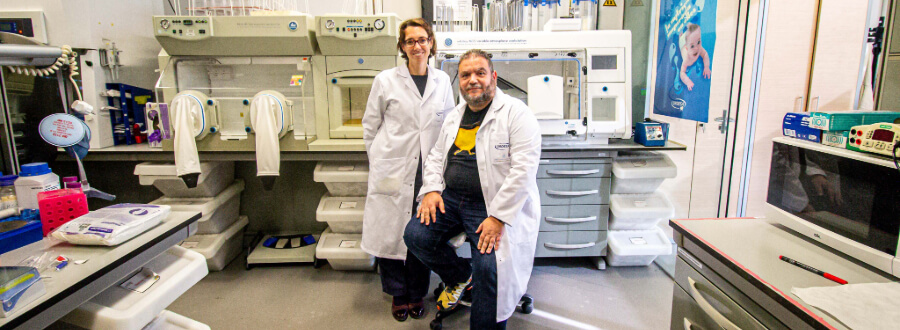
A study led by Laboratorios Ordesa identifies two probiotic strains that reduce preterm births by half
A study led by the R&D&i centre of Laboratorios Ordesa, located in the Barcelona Science Park, together with Eurecat and the Rovira i Virgili University (URV), has shown that cell-free supernatants of Bifidobacterium longum subsp. infantis CECT 7210 and Lacticaseibacillus paracasei CECT 30660 reduce inflammation during pregnancy and show preventive potential against infection-induced preterm birth. The results, published in the journal Nutrients, point to a new strategy based on bacterial compounds to modulate the maternal immune response and protect fetal health.
Cell-free supernatants obtained from two bacterial strains developed by Laboratorios Ordesa have been shown to reduce the incidence of preterm birth and modulate inflammation in an animal model. The two probiotic strains, Bifidobacterium longum subsp. infantis CECT 7210 and Lacticaseibacillus paracasei CECT 30660, reduced the rate of preterm births from 85.6 % to 42.8 % in pregnant mice subjected to a lipopolysaccharide (LPS)-induced inflammation model.
“We have observed a very clear and consistent effect. The mice treated with the combination of supernatants showed a more controlled inflammatory response and a 50 % reduction in the incidence of preterm births,” explains Dr. Xavier Escoté, researcher at URV and corresponding author of the study. “These results are robust and encourage us to continue investigating the role of bioactive compounds derived from bacteria in the prevention of preterm birth.”
Preterm birth—when delivery occurs before 37 weeks of gestation—affects approximately 11 % of pregnancies worldwide, equivalent to about 15 million cases each year. In addition to increasing the risk of neonatal complications, it can have long-term consequences for the newborn’s health.
“The number of preterm births continues to rise, and unfortunately, it is an increasingly common situation,” says Dr. Xavier Escoté. “It is something close to all of us, because, to a greater or lesser extent, we all know someone in our environment who has experienced a preterm birth.”
Among its most common causes is inflammation during pregnancy, which can arise from infections or imbalances in the vaginal microbiota. In this study, the researchers used an experimental model in pregnant mice that were administered LPS, a bacterial molecule that triggers a strong inflammatory response.
Anti-inflammatory and modulatory effect of the supernatants
The treatment also decreased levels of proinflammatory cytokines, such as tumour necrosis factor-alpha (TNF-α) and interleukin 6 (IL-6), both in maternal plasma and uterine tissue, reflecting a more controlled inflammatory response. In contrast, progesterone and oxytocin levels remained stable, suggesting that the protective effect does not depend on hormonal changes but rather on a direct modulation of the immune system.
Innovation and protection through an international patent
The bacterial strains used as the source of these compounds are part of Laboratorios Ordesa’s research line on microbiota and bioactive compounds. The strain Bifidobacterium longum subsp. infantis CECT 7210, known as B. infantis IM1®, has previously shown anti-inflammatory properties and the ability to support intestinal microbiota balance. Meanwhile, Lacticaseibacillus paracasei CECT 30660, isolated from vaginal samples of healthy women, is characterized by its high production of L-lactic acid (94 % of the total) and its activity against the pathogen S. agalactiae.
Both strains and the combination of their supernatants are protected by international patent WO 2025132375 A1, published in June 2025, which describes their use in maintaining vaginal health and preventing inflammatory processes associated with pregnancy.
“This work is also an example of successful collaboration between public and private research,” adds Dr. José Antonio Moreno, researcher at Laboratorios Ordesa. “The partnership between Laboratorios Ordesa, URV, and Eurecat has made it possible to validate an innovative approach with consistent results, laying the groundwork for future clinical applications.”
Application in the care of the female microbiota
The results of this study reinforce the scientific basis supporting the development of solutions based on bacterial metabolites to promote the balance of the intimate microbiota and reduce the effects of inflammation. This line of research is linked to the development of the new product DONNAplus Flora Intima INMUNO, formulated by Laboratorios Ordesa, which includes probiotics, prebiotics, and essential micronutrients that provide a triple action: preventing new infections, improving post-infection recovery, and offering greater protection for intimate health.
» Article of reference: Quesada-Vázquez S, De Almagro García MC, Cifuentes-Orjuela G, Antolín A, Alcaide-Hidalgo JM, Jiménez J, Francesc Puiggròs, Caimari A, Sabench F, Josep Del Bas JM, Escoté X and Moreno-Muñoz JA. A Combination of Lacticaseibacillus paracasei CECT 30660 and Bifidobacterium longum subsp. infantis CECT 7210 Cell-Free Supernatants Reduces LPS-Induced Preterm Birth and Systemic Inflammation in Pregnant Mice. Nutrients 2025, 17(21), 3429. doi: 10.3390/nu17213429
» Access to the news: Laboratorios Ordesa website [+]