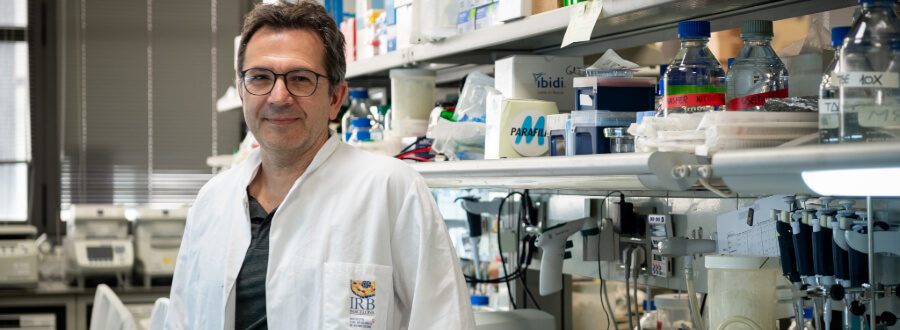
Raúl Méndez, deputy director at IRB Barcelona: “In my position, I want to contribute to the IRB left to us by Joan Guinovart to continue to grow as a benchmark European centre in biomedical research”
The deputy director of the IRB Barcelona is an international leader in gene regulation. His career has focused on protein translation processes, which are essential for cellular function and related to the development of diseases such as cancer. His recent discovery of the molecular mechanisms involved in autism has opened up new research perspectives. He currently leads the Translation Regulation group at IRB Barcelona and is an active member of the European Molecular Biology Organization (EMBO).
Your research in molecular biology has largely focused on cancer. In what way does the study of the regulation of protein production help to better understand the onset of this disease, and what advantages does this approach offer compared to other research methods?
Most diseases originate from the incorrect expression of genes at the protein level, a process that involves multiple steps. DNA must be transcribed into RNA, which then undergoes splicing, passes into the cytoplasm, and there the ribosomes translate it into proteins, which are responsible for carrying out cellular functions. Although transcription has been studied more extensively, it is clear that each of these steps has a similar regulatory potential and that failures in any of them can therefore cause disease. In some cases, one step may play a more prominent role than another, but ultimately they all take part. Our team is among those contributing to the study of post-translational regulation at the IRB, fields that have been undervalued from a therapeutic perspective, but where many opportunities may exist for the development of new diagnostic tools.
Are you referring to the creation of companies or entrepreneurial projects in the therapeutic field, or to something more fundamental, such as research groups?
It is an underrepresentation that spans from the academic to the clinical sphere. Few therapies have been approved or have reached patients with splicing or translation as their target, and even fewer companies are investigating compounds focused on these processes, which reflects the same proportion seen in published articles; it is a fundamental issue. There are some successful examples of companies specializing in the modification of alternative splicing for neuromuscular and neurodegenerative diseases—previously untreatable conditions where past attempts had failed—that now have clinical treatments achieving remarkable success.
Do you think this has been a natural evolution within the study of molecular biology? That is, was it necessary to start there in order to eventually reach your field?
I believe it is because the techniques for the initial steps were more refined. Since they are the first stages, they are easier to detect, whereas the later steps involve more noise and require more complex techniques, and that is why they have been less developed.
Speaking of technology, I understand that the advances made in recent years have also facilitated your research…
Absolutely, although the techniques to study transcriptional changes are always one step ahead. Single-cell sequencing technology or spatial transcriptomics allows us to see things we could not even imagine before, but they only work at the transcriptional level. At the post-transcriptional level they are not developed enough yet, and we still cannot use them. And that happens for the reason I mentioned earlier: they are more difficult to implement. In other words, one reason why this field is still underexplored is that the technology needed to study it lags behind compared to others.
You have studied both embryonic development and adult cells. What motivated you to investigate their role in diseases such as cancer?
In the early stages of embryonic development, there is no transcription. The genes required for the first cell divisions are stored as maternal RNA in the egg, representing up to 80% of the genome. As development progresses, specific RNAs are activated to produce proteins. Early embryonic development is regulated at the level of translation, which has attracted the interest of many research groups. We discovered that some of the mechanisms present during embryonic divisions are repeated in somatic divisions in adults, helping to understand processes such as homeostasis and cellular regeneration. We also observed that certain embryonic development mechanisms, which disappear in adulthood, are reactivated in tumours, offering a new therapeutic angle.
How can the study of the regulation of gene translation contribute to the development of new therapies?
There are more than 500 RNA-binding proteins in cells, which means that 80% of the genome is affected by post-transcriptional regulation. Our team studies a family of proteins, CPEB1, CPEB2, CPEB3 and CPEB4, which regulate 20% of the genome. Although there are few approved therapies in this hitherto underexplored field, translational regulation offers great therapeutic potential. Unlike transcription, which functions as a switch, translation acts as a rheostat, more finely modulating gene expression, allowing more precise control of treatment and potentially generating fewer side effects (e.g. affecting more of the tumour and less of healthy tissue). In addition, it is key in neurons, where it allows localised expression at synapses that cannot be achieved by transcriptional regulation alone.
When you mention more subtle therapies, do you mean a more personalized approach?
More specific. That is, therapies that target the tumour cell more and the healthy cell less. Personalized therapies treat each patient as a unique case, and for a time they were a major focus. But I think they are now losing momentum, partly because they are very difficult to implement. A healthcare system in which every patient requires a different therapy may not be sustainable. That is why the focus is shifting back to pan-cancer therapies, which allow treatment not only for many patients with the same type of tumour but also for different types of tumours.
One of your goals is to understand how some of the fundamental processes of life, such as embryonic development, are regulated. Does this mean we could prevent cellular abnormalities or developmental disorders before birth?
Detecting any abnormality in the embryo is very challenging, and in the few cases where it is possible, the techniques only allow us to observe genes or transcription, but never post-transcriptional regulation. I believe that at present there is no tool that allows us to detect post-transcriptional problems in the embryo, although it is possible at birth. One limitation of neuronal problems caused by post-transcriptional defects is that there are no mutations, which means they can only be detected in neurons, and a major challenge is obtaining biopsies. One of the approaches we are working on, together with other researchers, is to find another type of cell that could reflect what is happening in neurons at the post-transcriptional level. This is not easy, but there does seem to be some hope. Detecting mutations is simpler, because in many cases the mutation affecting the neuron is also present in other cells, especially if it occurred in the germline or during embryonic development, and can be identified in multiple tissues. In contrast, at the post-transcriptional level it is more complicated, since this regulation is more tissue-specific, making detection outside neurons much more difficult.
Your team has discovered a molecular mechanism related to the CPEB4 protein that could explain idiopathic autism. What therapeutic perspectives does this discovery open up?
Eric Kandel received the Nobel Prize in Medicine in 2000 for demonstrating that long-term memory is based on the localised synthesis of proteins at synapses. Synapses are capable of remembering if they have been previously stimulated, and they do so through translational control regulated by synaptic activation. The basis of all this is that RNA transcribed in the nucleus is exported to the cytoplasm, silenced, transported to the postsynaptic density, and stored there in a silenced state. When the synapse is stimulated, the translation of this stored RNA is activated, producing the corresponding proteins. This mechanism is fundamental for the formation of long-term memory.
In this sense, during my postdoctoral research at the University of Massachusetts, we discovered that the CPEB family of proteins, which I study in embryonic development, are responsible for repressing RNA and transporting it to the synapse. Years later, together with José Lucas’ neurobiology group at the Severo Ochoa Molecular Biology Center in Madrid, we discovered the involvement of CPEB proteins in autism and demonstrated that CPEB4 has a neuronal microexon that is lost in patients with idiopathic autism, which we published in Nature in 2018.
However, we could not explain why CPEB4 requires this specific microexon in neurons or how its loss affects its function. To delve deeper into this question, we collaborated with Xavier Salvatella at IRB Barcelona, which allowed us to publish a second Nature article at the end of 2024. This is not the main research line of our laboratories; these are synergistic projects that arise serendipitously because we recognized their potential. Currently, we are in the phase of contacting investors and exploring whether we can take the next steps toward clinical application.
When you mention investors, should we understand that you are interested in creating something from this?
At the stage we are at, this finding raises a series of very interesting questions from an academic and biological perspective, but it also opens the door to potential therapeutic approaches that no longer correspond so much to the university environment, but rather to a possible spinoff. Two promising lines emerge. The first is diagnostic: in theory, if we could detect the loss of this microexon, we might even be able to predict the severity of autism, although, once again, we face the difficulty of obtaining brain biopsies or finding another cell type that reflects what is happening in neurons. This is a path we are beginning to explore with a view to developing diagnostic tools. The second is based on the deep mechanistic knowledge we have acquired about this process, which allows us to imagine very specific therapies, targeting either the protein or the RNA. This is the line of work we are currently pursuing.
What are IRB Barcelona’s future plans to establish itself as a benchmark in biomedical research, and which areas do you think will be priorities in the coming years?
We are a research center focused on biomedicine, with a high percentage of our publications produced in collaboration with hospitals. We operate in the realm of preclinical and postclinical research, which brings us closer to hospitals and allows us to address biomedical and health-related problems. We have three programs that reflect this orientation. One focuses on cancer, with a particular emphasis on metastasis. Another program addresses metabolism and aging, which not only includes cancer but also liver diseases, immune degeneration, and disruptions in circadian rhythms. The third program is dedicated to the mechanisms of disease, aiming to understand underlying processes rather than merely describing symptoms. We want to use this deep knowledge to develop new therapies and innovative approaches. One of IRB’s strengths is the use of preclinical models to study diseases. Although cancer has been extensively studied at the cellular level, we know it is a complex process in which tumor cells interact with their niche, the immune system, and other factors, such as systemic inflammation. This systemic approach is also key in the study of aging and metabolism, and it constitutes one of IRB’s major strengths, where we analyze how cells interact with each other at a systemic level with a very detailed mechanistic understanding.
Your arrival at IRB Barcelona in 2010 aimed to promote interdisciplinary biomedical research at the center. How do you think you have achieved this goal?
I’m not sure if we have fully achieved it, but it is true that all the work we have published has been in collaboration with other groups at IRB Barcelona; I don’t think we have published any work on our own. My group brought very specific mechanistic expertise, which has benefited enormously from the knowledge already present at IRB in disease research. This confluence between strong groups studying cancer and metabolism has allowed us to bring mechanistic knowledge closer to patient-focused research, and now our work is much more directly related to the patient and the disease than it was when we first arrived at IRB. But we do this because we collaborate with about half of the groups at IRB. For us, the IRB environment—being so close to clinical, preclinical, and postclinical work in Barcelona hospitals—has been enormously beneficial. I’d like to think that this has been mutual and that we have also contributed something to the groups already at IRB, but for us, it has been absolutely crucial. If we were somewhere else, we would not be doing this type of research.
You have been IRB Deputy Director since 2018. Do you think scientists should be more involved and more aware of management issues?
I think they should be more involved in science policy planning. Taking on a position of responsibility is one way of getting involved, but not the only one. It is essential for scientists to get actively involved in science policy development, not just as consultants, but by making strategic decisions for the community. Being deputy director is a way of contributing and, from my position, I want to help IRB Barcelona continue to be the centre left to use by Joan Guinovart, who did a spectacular job in positioning it internationally. Francesc Posas, an excellent scientist with a great deal of management experience, has taken over, and I intend to contribute as deputy director, so that the Institute maintains a quality trajectory that strengthens its position as a European benchmark in the field of biomedicine.