The IBUB deciphers the mechanism that determines the complexity of the glucocorticoid receptor
Researchers from the Institute of Biomedicine of the University of Barcelona (IBUB), based at the Barcelona Science Park, have revealed the mechanism of multimerization —the union of several molecules to form complex structures— of the glucocorticoid receptor, a decisive process for its physiological function. The glucocorticoid receptor (GR) is essential for regulating vital processes in various tissues; therefore, understanding its structure and functioning at the molecular scale is fundamental for designing more effective and safer drugs. The study, published in the prestigious journal Nucleic Acids Research (NAR), opens a crucial path toward developing more selective drugs capable of modulating this association and thus minimizing serious adverse effects such as immunosuppression or bone loss.
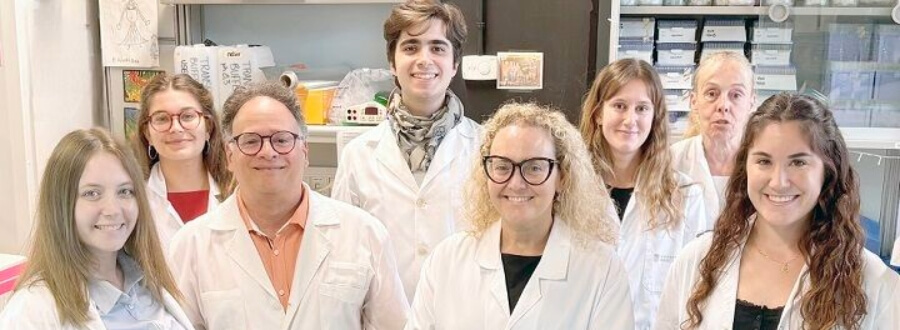
The research was led by Eva Estébanez-Perpiñá, a Serra Húnter professor in the Department of Biochemistry and Molecular Biomedicine of the Faculty of Biology and at the IBUB. The young researchers Andrea Alegre Martí and Alba Jiménez Panizo, also from the IBUB, are listed as the first co-authors of the study.
The study, notable for its multidisciplinary approach, is the result of a broad national and international collaboration that brought together teams led by Gordon L. Hager from the U.S. National Institutes of Health (NIH), and Jaime Rubio Martínez and M. Núria Peralta Moreno from the Faculty of Chemistry and the Institute of Theoretical and Computational Chemistry (IQTCUB) of the University of Barcelona. It also involved members of the Mass Spectrometry Core Facility at the Institute for Research in Biomedicine (IRB Barcelona), the Institute of Grapevine and Wine Sciences (ICVV-CSIC), the Institute of Biomedicine of Valencia (IBV-CSIC), and the University of Buenos Aires (Argentina).
A flexible protein with multiple conformations
For decades, the scientific community had considered that the GR acted only as a monomer or as a homodimer (i.e. one or two copies of the receptor). This study breaks from the traditional model and reveals, for the first time, that inside the cell nucleus the receptor forms larger oligomers, mainly composed of four subunits (tetramers).
“The glucocorticoid receptor controls approximately 20% of the human transcriptome and is fundamental in the regulation of glycaemia, metabolism and the anti-inflammatory response.
“This is, in fact, the first time that we present to the scientific community a coherent mechanism to explain how the GR associates within the cell nucleus. These results reaffirm the importance of further research to experimentally determine the three-dimensional structures of proteins and their complexes”, explains Professor Estébanez-Perpiñá.
The formation of these complexes occurs thanks to the interactions identified by the team, which are specific to the ligand-binding domain of the GR. While in a previous study (Nucleic Acids Research, 2022) the team identified 20 different forms of association between the subunits, the new study goes further and defines which oligomeric forms are most relevant to the physiological function of the GR.
“The GR’s active conformation is clearly different from the traditional model that has been described for other nuclear receptors,” says researcher and author Pablo Fuentes-Prior, from IBUB. “As we published in 2022, the functional unit is a non-canonical homodimer that associates via the first helices of the ligand-binding domain. This confirms that the GR functions differently from its homologues.”
The new study confirms that this basic dimer is essential for the transcriptional function of the receptor “and, moreover, functions as a kind of building block in a molecular LEGO to form more complex structures”. “These structures, mostly tetramers, are the ones that really represent the active form of the GR when it binds to DNA,” note Alegre-Martí and Jiménez-Panizo.
The active conformation of the GR demonstrates high plasticity in its dimer interaction surface. This flexibility allows it to adopt a range of more open or more closed structures. “This oscillation between different conformations is essential to ensure the correct functioning of the transcriptional machinery that the GR coordinates,” says Fuentes-Prior.
Mutations affecting the glucocorticoid receptor
Mutations in the GR gene can directly alter the multimerization process, leading to aberrant forms and loss of protein functionality. This is what happens in Chrousos syndrome, a rare disease characterized by glucocorticoid resistance and severe immune, metabolic and growth disturbances.
The study adds to the knowledge of the molecular mechanisms of the disease caused by these mutations and presents a comprehensive catalogue of pathological variants, mainly located on the surface of the ligand-binding domain. In contrast to mutations in the hormone-binding pocket — the pathogenicity of which was already known — this paper explains for the first time the effect of mutations in surface residues of the domain associated with glucocorticoid resistance, without a clear explanation to date. Some of these mutations weaken the dimer and interfere with its formation. Most often, mutations increase the hydrophobicity of the receptor surface, forcing the formation of larger structures (hexamers and octamers) with reduced transcriptional activity.
“Apart from autoimmune and inflammatory diseases, these findings open new avenues to address diseases associated with GR dysfunction, including asthma, Cushing’s syndrome and Addison’s disease. Ultimately, our research lays the foundation for the design of precision drugs capable of modulating GR function with unprecedented specificity,” concludes the research team.
» Article of reference: Alegre-Martí, Andrea et al. «The multimerization pathway of the glucocorticoid receptor». Nucleic Acids Research, octubre de 2025. doi: 10.1093/nar/gkaf1003
» Link to the news: University of Barcelona website [+]