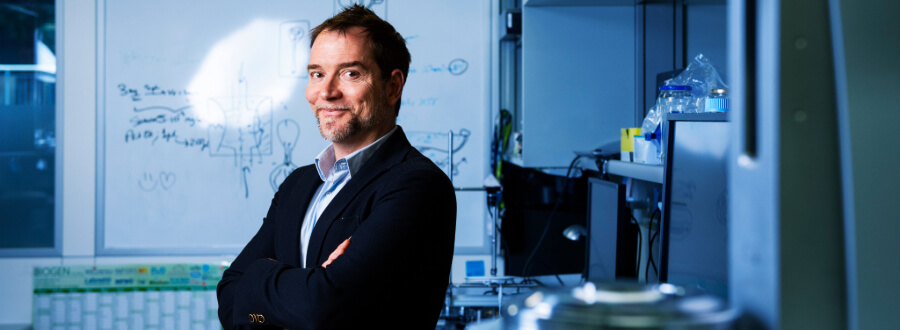
Samuel Sánchez, co-founder and CEO of Nanobots Therapeutics: “Not everything that is made in the lab can make it to the market. The challenge is to spot the one in a thousand who really have a chance”
He says so himself: he loves to get into trouble. And perhaps for that reason, the awards keep coming his way. He has broken two Guinness World Records for creating the world’s smallest jet and has received distinctions such as the MIT Award for Innovators Under 35 (2014), the Princess of Girona Foundation Scientific Research Award (2015) and the Spanish National Research Award for Young Talent (2016). Currently, Samuel Sánchez is an ICREA professor, deputy director of the Institute for Bioengineering of Catalonia (IBEC), and, with nearly 200 publications and 8 patents in progress, he founded the IBEC and ICREA spin-off Nanobots Therapeutics in 2023.
Even though you hold a PhD in chemistry, you soon steered your career toward bioengineering. Do you think it was the major advances in biomedicine at the beginning of the 21st century that, in some way, influenced your decision?
I always knew I wanted to study biochemistry. Bioengineering, on the other hand, was a field I didn’t know much about, even though I did my thesis on biosensors. The truth is that I’ve adapted my research to the places where I’ve been, depending on the environment and the available infrastructure. I started working on biosensors because my goal was to do biochemistry. Then, in Japan, I fully immersed myself in nanotechnology, and later, in Germany, I focused more on physics and materials. At the Max Planck Institute, I began my path in nanorobotics, and when I arrived at IBEC, I focused on applying our technology to biomedicine. It’s not that I had a very clear plan, honestly—it’s been more of a mix of serendipity and the opportunities that came up. What’s most important is that I’ve always been surrounded by great talents and scientists, and that’s been key to learning and adapting. I’ve learned from physicists, chemists, materials scientists, biologists—and little by little, I realized that what we were doing could have medical applications. A postdoctoral researcher once told me a phrase that I still use fifteen years later: urease moves with urea, urea is in urine, urine is in the bladder—so why don’t we use it for bladder cancer? On top of that, it happened that a relative and a friend of mine have this type of cancer, and all of that helped add extra motivation. So I went for it. It’s about listening to the people around you. My decisions have been shaped by how things have unfolded, by adapting, and by looking for ways to make the most of the technology and the advances developed in my group.
You’re a leading figure in nanorobotics, you’ve received major awards, and you lead both a laboratory and a spin-off. From your experience, which challenge is greater—the scientific one or the entrepreneurial one?
I think it’s more challenging to develop a technology that can truly be translated to the clinic and reach the market. Science, if you surround yourself with good people and have an innovative idea, eventually bears fruit. The real challenge is to dissect what it is in your research that can actually become accessible to patients. The scaling process, regulation, and getting the consensus of clinicians, investors, and lawyers is something I’m learning about every day—and it’s exciting. As a scientist, it’s a dream to see your work lead to a clinical trial in humans. As an entrepreneur, the dream is to see what you’re doing reach the market—or to have someone buy it. But not everything developed in the lab can become a product. The challenge is to detect, among everything we do, that one in a thousand (or fewer) that truly has potential.
A large part of your research focuses on cancer treatment, and you’ve already achieved significant progress in animal models for bladder cancer. What are the main challenges in bringing nanobots from the lab to the patient?
The biggest challenges now are no longer scientific, but everything that comes after. Turning an innovative technology into a real treatment means overcoming barriers in manufacturing, regulation, investment, and market access. We have a disruptive technology—capable of reducing a tumor by 90% with a single dose, something unprecedented—but the key questions are different: Who’s going to pay for it? Will there be investors willing to back something this innovative? Will clinicians adopt it? What will regulatory agencies say? It works in the lab, but we need a company to scale it up under GMP standards and handle quality control, because what we do here can’t go straight to the clinic—there’s always an intermediate step. And what does all that require? Money. This is where you enter what’s known as the Valley of Death, because even if you have a powerful technology, without sufficient investment, you can’t move forward. Last year, we secured a total of €3.3 million, but we know that to complete the trials and reach the clinic, we’ll need to multiply that figure.
Many imagine nanobots as tiny robots that travel through the body to treat disease. Even you describe them as “little submarines”. What is needed to ensure their safety for patients?
What we really make are nanomotors, because our technology converts chemical energy into motion; and that is, by definition, a nanomotor. The first requirement is simplicity, because from a regulatory standpoint, any system that’s too complex has little chance of being accepted. When you talk to regulators, their reaction is usually immediate: “your nanobot is very complicated.” And yet, it only has three components: a particle, an enzyme as the propulsion motor, and a drug. Even if the drug is approved, it’s necessary to demonstrate that the nanobot is biocompatible and that neither the enzyme nor the particle causes any adverse effects in the body—that is, they act only as excipients.
Currently, you are obtaining promising results in preclinical phases with animal models for bladder cancer treatment. When do you think you will be able to make the leap to clinical trials in humans?
We have about a year and a half, or at most two years, left to complete the preclinical phase and move on to the clinical phase. We expect that by the end of 2026, the preclinical phase will be finished.
Your technology improves drug delivery and tissue penetration. Could this be an opportunity to treat currently untreated diseases?
Yes, that’s exactly the area my group at IBEC is working on. Between 2021 and 2024, we began to understand that nanobots don’t just move—they can also cross biological barriers, which represents a major breakthrough in nanomedicine. This is one of the main challenges in the field: overcoming the obstacles surrounding tumors and cells to make treatment more effective. In cases like lung, breast, or ovarian cancer, mucous membranes protect the tumors and at the same time prevent drugs from penetrating—they tend to stay on the outside. But nanobots can perforate and pass through these mucous barriers, so we’re already working on other indications where this could also work, such as treatments for the knee, eye, colon, and skin. We’re opening up these research lines, and I believe that within four years, we’ll be in a position to choose what the next indication will be.
From your experience as CEO of Nanobots Therapeutics, what role do collaborations with other institutions and private investment play in the development of this technology? Do you consider it an attractive field for investment?
I believe we have a versatile technology that generally generates interest, and behind it is an outstanding team working hard. To validate the unmet medical need we address in our proof of concept—bladder cancer—as well as the next steps, we have the support of our Clinical Advisory Board, which includes expert uro-oncologists. We also maintain very close collaborations with CIC biomaGUNE, IRB, and UAB, in addition to advisors in CMC like LeanBio, and regulatory experts. Some of these contacts are at the PCB, and it’s fantastic to have them so close by. Because you can’t know everything, and it’s important to surround yourself with the best talent. Currently, we have public and private funding (approximately one-third and two-thirds of the total, respectively), and we’re making progress with our candidate to obtain in vivo data that will allow us to confidently move into regulatory preclinical phases. We’re in contact with the main local investment funds and with a growing number of international funds, and simultaneously, we’re establishing connections with pharmaceutical companies that our technology can help make more efficient.
After working in several laboratories and universities around the world, you decided to settle in Barcelona. What makes our scientific ecosystem unique?
The PCB is the place to be. In my lab, we have nothing to envy compared to what we had at Leibniz or Max Planck: we have top-level infrastructure and a great atmosphere. Along with other excellent collaborators, we wouldn’t have achieved last year’s article in Nature Nanotechnology without knowing Julien Colombelli from IRB Barcelona. Thanks to him, we made a huge leap forward in imaging techniques. Meeting someone who has complementary techniques to yours makes you want to stay—and you appreciate the importance of the ecosystem even more. In the entrepreneurial realm, it’s easy to meet colleagues and realize it’s a small world with a good vibe. I like that you quickly learn from others and take part in the events organized here. All of this is thanks to being at the PCB.
In 2024, you won a Guinness World Record for creating the smallest reaction motor in the world. Although it’s an unusual recognition for a researcher, do you think it also reflects the great potential of nanoscience?
We actually have two Guinness World Records, one from 2010 and another from 2016. The first came thanks to a PhD student we had that year—it was him who had the idea to apply. But the hardest part was finding the right definition for what we were presenting. We thought: after all, it’s basically a turbine, a jet. So, at that time, the largest in the world was the Boeing 777’s engine, and the smallest was ours. The second record came in 2016 and was three times smaller. To be specific, the first had a diameter of 600 nanometers, and the second, 220 nanometers. It’s funny because sometimes I think maybe I’m one of the few people with a Guinness World Record… and without being such a geek!
Finally, here at the PCB we have the Research in Society program, dedicated to outreach and encouraging scientific vocations among young people. At IBEC, you also carry out similar initiatives. How do you view these kinds of programs? Are they still necessary, or do you think science is already attractive enough to young people?
Since I arrived in Barcelona in 2015, I’ve been deeply involved in scientific outreach initiatives, both with IBEC and with the Catalan Foundation for Research, the Pedrera Foundation, and others. For me, it’s fundamental. I especially remember one event in 2015 at Dolors Aleu conference room, attended by family, friends, and some students—one of whom ended up doing their PhD with me, and another became my business partner years later. It’s crucial to reach out to society to show not only what we do in research but also what emerging companies are working on. Regarding scientific vocations, I see a clear bipolarization: on one hand, those who pursue science for the love of basic research—about two out of ten students—and on the other, those who look for concrete applications. Nowadays, they come to you saying they want to focus on applications in breast cancer or lung cancer. Most are focused on the “what for” rather than the “why,” and that’s a trend I didn’t see as much before. It’s good, but we mustn’t forget fundamental science.