Anna Mezquita, head of Works: “Our premise is that sustainability takes precedence over aesthetics”
Antoni Gaudí said that “architecture is not just an art, it’s a science”, a reflection that fits in with the job of the head of Works at the Barcelona Science Park (PCB), who has the immense responsibility of erecting inspiring spaces designed to encourage innovation and scientific progress, creating environments that foster creativity and collaboration.
What are the main challenges when it comes to the development of new spaces? Is there a blueprint for setting up a laboratory?
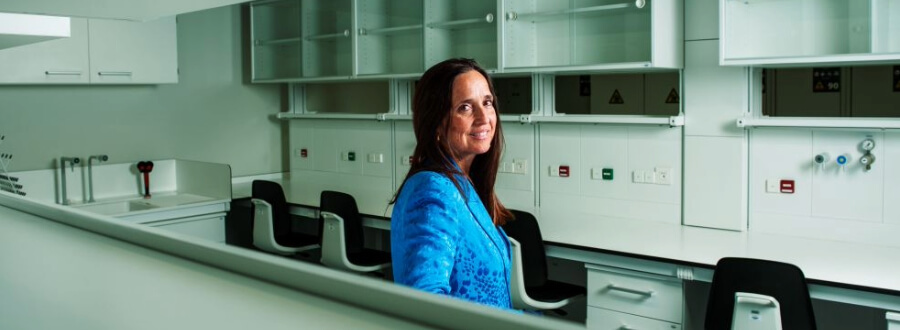
At the Scientific Park, we try to standardize spaces so that they follow a coherent line under the same brand. This allows a space to be reused by the next client with minimal intervention if one client leaves. For example, in the Cluster II laboratories, intended for the BCN Health Booster accelerator, we designed standardized laboratories for small companies. It is essential to carefully define the placement of elements to ensure the proper functioning of the facilities and to allow a coherent and systematized circulation that can easily accommodate the needs of new occupants in case of a user change. The separation of the wet lab (for experiments involving liquids or fumes) from the dry lab (more similar to an office) is another basic feature of our laboratories, as well as providing maximum natural light and comfort so that the laboratories become optimal spaces for working.
What criteria are followed to design and organize the spaces at the Scientific Park?
The more flexible a container is, the easier it is to adapt it to future changes and new usage strategies, as everything evolves. When I started in 1999, the mentality in this field was still very limited, but the PCB’s construction was designed to be a set of large containers with bays that allowed for maximum versatility, without intermediate pillars. It was a very innovative approach, and prefabricated materials facilitated industrialisation and lent themselves to sustainability. When things are handcrafted, they require more time and the margin for error is greater. That is why we must design spaces that serve a range of purposes, that are open and flexible, because the more modular and flexible they are, the easier it is to adapt them to change economically.
What is the average number of projects you develop per year, and what do you believe are the benefits for the Park’s clients?
Last year, just for clients, we carried out around 98 projects, including minor renovations. We manage the entire process internally, which benefits the final outcome. We could outsource renovation work, but that would make us less efficient and more expensive. Being involved in every step of a project gives us greater control, and in a complex centre like the Barcelona Scientific Park, this is a guarantee of safety and quality. Clients at the Park have an in-house service that provides “turnkey” solutions and allows them to fully delegate the oversight of the works. It is important to highlight that the smooth operation of the entire process depends on the work of the entire PCB team, which makes this level of efficiency possible.
How does sustainability influence the design of a research centre such as the PCB?
Our premise is that sustainability takes precedence over aesthetics. We prioritise environmentally friendly materials and give a second life to reusable items such as partitions and laboratory furniture. Designing with sustainable and flexible materials, ensuring a long service life, is essential.
Which project have you enjoyed the most? Do you have a particular anecdote?
It is difficult to choose a favourite project because each assignment is a different challenge and responds to new needs, which already makes it appealing from the start. Perhaps due to its complexity and, at the same time, the opportunity it presented, the drafting of the special plan and the basic project for the Hèlix Building was one of the most interesting challenges I have faced. It allowed us to provide the PCB with additional research space quickly, while awaiting the completion of the construction of the new buildings in the second phase. The building was constructed with a prefabricated structure, very innovative at the time, and has since become one of the landmark buildings of the Barcelona Scientific Park. During this process, I was also entrusted with the urbanization of Baldiri Reixac Street, which we transformed into a pedestrian zone, anticipating a trend that would come later: removing cars.
I also greatly enjoyed designing the bar on the Park Terrace, the first meeting space we created for the PCB community, located on one of the rooftop terraces. It enabled the exchange of ideas among the first researchers who occupied the Park’s spaces. The variety of assignments and interlocutors provides constant learning and a great professional enrichment.